
McIntosh County Criminal Docket Searches
For an online search, begin with the Georgia Courts E-Access directory. It lists both McIntosh Superior and State courts. It points you to the participating provider, re:SearchGA. An account is required. What you can see depends on the court, the case type, and your user role. A restricted screen does not mean no McIntosh County criminal docket exists. Search works best with the exact case number from an indictment, accusation, citation, or notice. No number? re:SearchGA still helps. Search by party, attorney, or judge, with a wildcard for names. When a record is missing, old, or just unclear, call the Clerk of Superior Court. That office manages Superior, State, and Juvenile court records in McIntosh County.
- Confirm whether the paper names Superior, State, Magistrate, Juvenile, Municipal, or federal court.
- Open E-Access, choose the McIntosh County court, and follow its provider link.
- Search Cases by exact number first; otherwise use a name and court or date filter.
- Open Case Details and read filing, hearing, plea, and disposition events in date order.
- Ask the proper clerk for an older file, access decision, or certified copy.
McIntosh Criminal Search in re:SearchGA
The provider guide draws a line between a search result and the documents behind it. Clicking a case description opens Case Details; a hearing type opens hearing details. Depending on your access level and the court's local integration, those details can include the case number and type, parties, attorneys, judicial officers, filings, documents, and hearings. Sometimes the index is open. An image may cost money or stay restricted. The re:SearchGA criminal search source is the official Tyler access point. It serves participating Georgia courts.
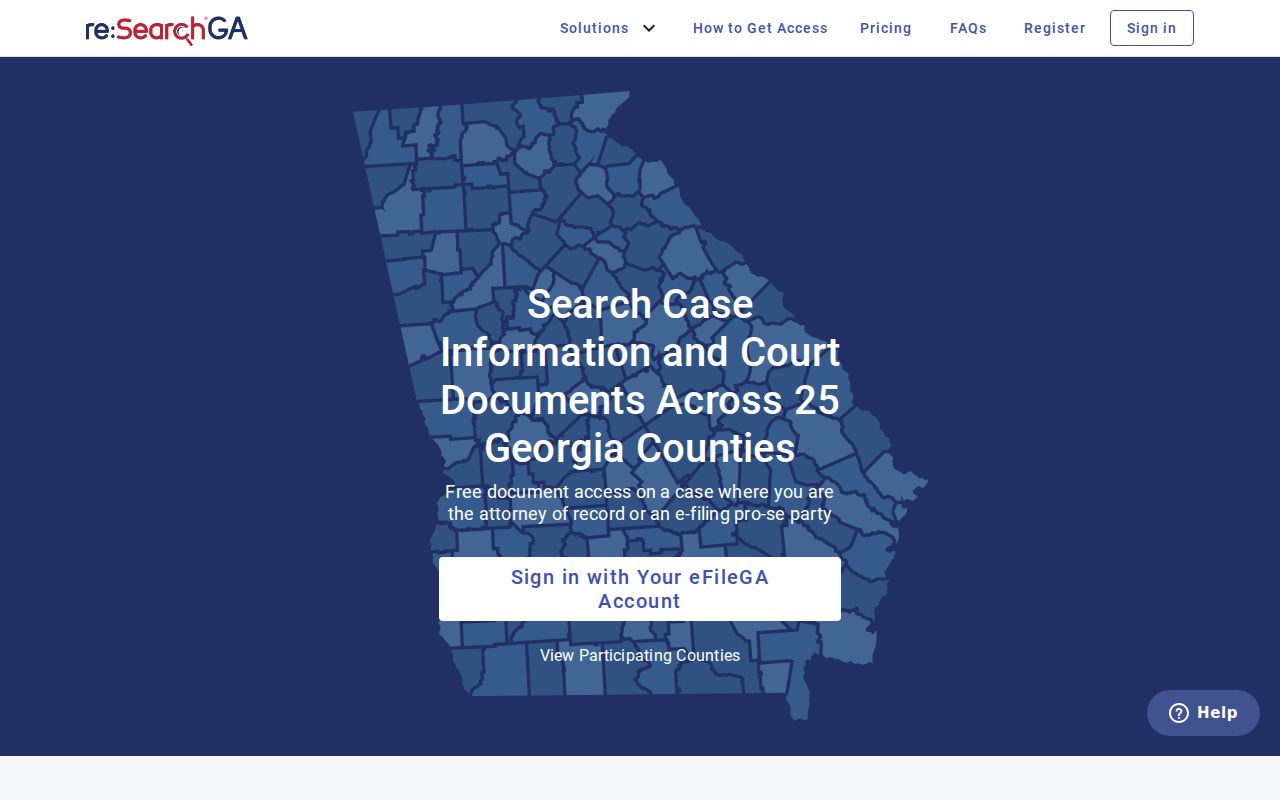
The screen shows the provider's front door, not any private case. Use its Cases and Hearings paths. Then confirm a current setting with the McIntosh County clerk. One format in eFileGA help is 2019-CR-012345: the year, then CR, then a zero-padded number. That is only a provider example. Older McIntosh entries may carry different punctuation.
Criminal Dockets: What They Show
Uniform Superior Court Rule 39.3 lays out what a Superior Court criminal docket should contain. Expect an action number, filing date, charge counts, defense counsel, the judge who entered final disposition, plea data, trial type, count outcomes, sentence details, and later review events. A public portal may show fewer of these fields than the clerk actually maintains.
| Case identifier | Unique action or indictment number and filing date, such as 2019-CR-012345. |
|---|---|
| Charge record | Indictment or accusation, counts, and felony, misdemeanor, traffic, or citation class. |
| Plea and trial | Plea by count and date, negotiated status, and jury or nonjury trial. |
| Disposition | Count result and date, such as dismissal, nolle prosequi, guilty, or not guilty. |
| Sentence and review | Terms, conditions, costs, fines, restitution, transcript, appeal, and remittitur. |
| File location | Minutes, final-record pages, and off-site storage box references. |
An event row is not the filed order. Read the later entries, because a plea, warrant, or motion may have been changed, returned, ruled on, or appealed since that line was written.
McIntosh Criminal Dispositions in Plain Terms
Disposition words can look final and still need the signed order for context. A reader of a McIntosh County criminal docket should separate a single count's result from the status of the whole case. An old warrant line proves nothing about its present status.
- Nolle prosequi
- The prosecution discontinued a count. It is not an acquittal after trial.
- Nolo contendere
- A plea category in Rule 39.3, not a not-guilty result.
- Negotiated plea
- The docket marks a negotiated plea; the sentence or order contains its terms.
- Dead docket
- An administrative status, not a conviction. Read the order for its effect.
- Remittitur
- The appellate result returned to the trial court.
Pending means no final disposition appears on the docket. It does not confirm the next hearing date. Check the Hearings tab where offered, and call the clerk, since the Atlantic Judicial Circuit posts no current public calendar.
Criminal Case Stages on the Docket
A felony docket usually opens with an accusation or indictment. From there it records a plea and the scheduled proceedings. Next come motions, trial entries, and count outcomes. A sentence entry can list its date, type, term, conditions, costs, fines, and restitution. An appeal stretches the record past the judgment. State, Magistrate, and Municipal matters may follow a different route. Keep the court name attached to every event.
Docket flow: Filing › Arraignment › Pretrial › Plea or Trial › Disposition › Sentencing
A setting is not a result. An arraignment, a pretrial conference, a plea date, and a trial setting each do different work, and a reset can add a new event without erasing the first row.
McIntosh Criminal Courts by Case Level
McIntosh County criminal dockets do not all live in one court. Felonies belong to Superior Court. State Court handles misdemeanors, traffic, warrants, and the preliminary work assigned to it. Magistrate Court keeps warrant and limited criminal categories. Darien Municipal Court covers city traffic, ordinances, preliminary hearings, and warrants. Juvenile cases run under a separate, confidential framework.
| Court | Criminal work | Access route |
|---|---|---|
| Superior | Felonies | re:SearchGA, then Superior clerk |
| State | Misdemeanors, traffic, warrants | Provider, then the same elected clerk |
| Magistrate | Warrants and limited matters | Probate/Magistrate office |
| Darien Municipal | City traffic and ordinances | Municipal clerk |
| Juvenile | Youth matters | Juvenile clerk under access rules |
The title "Superior Clerk" trips people up. Cheryl "Mandy" Harrison's office keeps Superior, State, and Juvenile records; Probate/Magistrate and Darien Municipal each hold their own.
McIntosh County Criminal Docket Courts
The charging paper is the safest clue for routing a search. Paying through a citation screen is not the same as pulling a full criminal docket. For Superior, State, or Juvenile records, the clerk's office sits at 310 North Way, Darien, with mail to P.O. Box 1661, Darien, GA 31305. Phone 912-437-6641. Hours run Monday through Friday, 8:00 a.m. to 5:00 p.m. Probate/Magistrate works from a separate office. A dated official guideline lists 912-437-4888, so confirm current practice. Darien Municipal Court lists 912-437-6644. Ask whether a public terminal is available. Call before mailing anything, since no certified-copy packet, fee, ID rule, or turnaround time is posted.
McIntosh Criminal Cases in Federal Court
Go federal when a notice names the United States. It may cite a federal indictment or statute, or point to the Southern District of Georgia. McIntosh County sits in that district's Brunswick Division. Federal records run on PACER and CM/ECF, not re:SearchGA, and the county clerk cannot certify them. The Southern District CM/ECF source shows this separate system.
A case showing on a federal screen sits in a different filing system. It is separate from the McIntosh County criminal docket. For federal searches, use PACER, and direct record questions to the Brunswick clerk. The courthouse sits at 801 Gloucester Street, Brunswick, GA 31520. The clerk's number is 912-280-1330. Federal fees and federal sealing rules do not carry over to a McIntosh County state record request.
Access Rules for Criminal Dockets
Georgia Uniform Superior Court Rule 21 treats court records as public. Still, access has limits. A court may restrict a file after the required process. Protected identifiers must be redacted or split off. Adoption indexes are sealed. Juvenile records stay confidential. Secured material may stay hidden from an ordinary portal account, so a docket entry does not guarantee a public image.
Georgia access rules:
Uniform Superior Court Rule 21 sets the process for limiting court-record access.
Rule 21.2 requires privacy harm to clearly outweigh public interest.
Rule 21.6 calls for a redacted public version before an unredacted protected filing is submitted for sealing in the stated cases.
When an image is restricted, note the visible identifier and ask the clerk what process applies. A blank portal does not mean no case exists. Inspection can happen online, at the counter, by a confirmed mail route, or through a terminal the clerk provides. Phone and fax are contact channels only. The clerk does not promise fax copy requests.
Older McIntosh Criminal Docket Files
Provider support says e-filed data starts with 2018 filings, and older integrations vary. So an old McIntosh County criminal docket may still sit at the clerk even when the portal shows nothing. Rule 39.3 anticipates minutes, final-record pages, and off-site box references that can help staff pull the file.
When you contact the clerk, give the court and the case number if known. Add the likely filing year, the event or document you want, and whether you need a plain or certified copy. Ask about turnaround time, fees, payment methods, ID, and delivery. McIntosh County has not posted those terms. A certified copy is a clerk-authenticated product. It is not a paid image, payment receipt, or printout pulled from the portal by default.
Deep research often takes more than one docket reference. A minutes page may point to a court act, and a final-record page can show where the lasting entry was recorded. An off-site box reference is only a retrieval aid. It says nothing about the document's contents. Ask for the actual filing or order tied to the event. Let the clerk confirm whether it can be inspected or copied. That route keeps an old McIntosh County criminal docket tied to its source. It avoids treating a short index line as the whole file.
Write down the clerk's current instructions before you send payment for any request. A mailed inquiry should state a return address and the format you want. Fax or email delivery should not be assumed. If the case went up on appeal, note the notice of appeal and remittitur dates. Those dates help staff separate the trial record from the appellate record.
Note: A missing image can reflect age, integration, price, or access limits rather than a missing criminal docket.